The Babbitt
Inside the babbitt process at Aldrich
Babbitt is what Shawn is known for at Aldrich Engine Rebuilding in Willington, Connecticut. The alloy is Grade 2 — about 90 percent tin, 7.5 percent antimony, 3.5 percent copper — poured by hand from a 1940s pot. This is how it happens, narrated by Hemmings Classic Car.
Why other shops won’t pour babbitt
With a new engine it is common practice to throw away the bearing inserts, including the cam bearing inserts. These parts are all easily replaced with new ones so that practice makes sense.
In an antique engine most parts are not easily replaceable. Many times the best method is reconditioning an original part. If that’s not possible even a severely damaged part can have critical importance for accurate measurements in machining a replacement. In a nutshell the work habits in a typical modern motor shop can end up with vital parts of your engine missing or destroyed.
Shawn’s well‑equipped machine shop can and does handle many major engine rebuilding tasks, including decking blocks, surfacing flywheels and grinding cranks, but what he’s known for is babbitt. He has a reputation for taking on the jobs that other people reject; in fact, even though Model A and T engines were his living for decades, he’d much rather have something more interesting and obscure.
The alloy itself
The material in the pots is a Grade 2 babbitt. Unlike what you might think, it’s about 90 percent tin, then about 7.5 percent antimony and 3.5 percent copper. Lead only makes up less than 0.5 percent, along with iron, arsenic, bismuth, zinc, cadmium and aluminum.
Grade 2 is sometimes known in the trade as high‑speed babbitt, and withstands friction and high temperatures.
“Many people will tell you babbitt is a science. I will tell you it’s an art. I don’t even try to pour on a rainy day.”
The pour
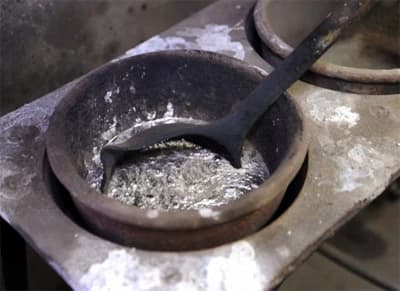
The babbitt material must be the correct temperature. Shawn is planning on building himself a digitally monitored station, but for now, it’s in a 1940s pot. Experience tells him it’s ready when it “flows like mercury.” Too cold, and the dissimilar metals aren’t properly combined; and he can tell when it’s too hot when it starts to oxidize and develops a golden sheen.
Babbitt can’t just sit in the pot, either, it must be stirred or the metals will begin settle into layers. The need to tend to the hot metal meant he was in constant motion.
Melting out the old babbitt
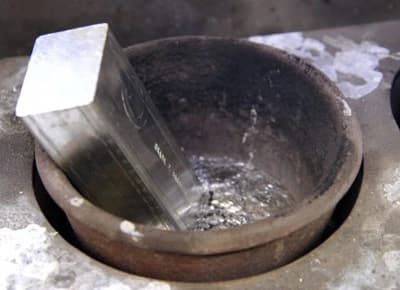
The first step is melting out the old babbitt, which Shawn does with a compressed air‑fed propane torch. Old timers would reuse the factory babbitt, but “you don’t know what GM used.” Shawn melts it down into little triangular ingots (or delta‑shaped, for change — a little engineering joke) that he returns to the customer.
It doesn’t take too long, though with the rod acting as a heat sink, a Model T goes a lot faster than a straight‑eight Buick.
Surface prep is everything
Just as in automotive painting, the most common cause of babbitt failure is incorrect surface preparation. Whether a rod bearing or main bearing, the surface must be absolutely clean and correctly treated.
Any old babbitt that doesn’t melt out is scraped away, then the surface gets wire brushed. Sandblasting removes the last traces of old babbitt, and after some more hand dressing, Shawn plugs up the oil passages with putty.
“Brushes are cheap, and returned rods suck.”
The pour itself
After Shawn is satisfied with the surface, he clamps the rod into a heated mold and pours his alloy, allowing for shrinkage in cooling. Tapping the part out with a lump hammer with a surface made from old babbitt, he finds any small pits from air bubbles. He’s able to puddle in some babbitt using a torch and a burin to concentrate the heat, as you would in soldering.
Now all that’s left is the time‑consuming filling in the oil grooves, drilling out oiling holes and cutting off the excess.
The tools
Every machine but one in Shawn’s shop is American‑made, most of them from within 50 or 100 miles of the shop — the old machinery centers of Springfield, Massachusetts, and Hartford, Connecticut. Little of the equipment dates to later than the Sixties; a few pieces are 1940s or 1930s.
He’d much rather restore a quality old piece of machinery than find a new one. He’s proud to be able to tell people that he uses the same equipment on their cars that would have been used when they were repaired in the day.
“I do the weird things most guys don’t want to do.”
Got a question? Call Shawn at 860-429-3111 · See services → · Read the process →